
There’s a particular moment that happens in almost every Indian woman’s wardrobe evolution. You stand in front of your closet — half of it traditional, half of it contemporary — and realise that what you actually want is something that speaks both languages at once. Something that feels rooted in where you come from but entirely of the moment you’re living in.
That’s exactly what Indo western outfits do.
They’re not a compromise between two aesthetics — they’re a conversation between them. A silk kurta with wide-leg palazzos. A saree draped with a tailored blazer. A fusion lehenga that photographs like couture but moves like something you’d actually wear past midnight. The best Indo western designs carry the craft of Indian textiles — hand embroidery, block print, zardozi — and give them silhouettes that feel sharp, contemporary, and entirely yours.
This guide walks through every category that matters: fusion wear for women, kurta sets, bridesmaid outfits India brides are actually choosing, and party wear sarees that command a room without trying to. With picks and styling notes from Reina’s curated multi-designer edit in Jubilee Hills.
What Makes an Outfit Truly Indo Western?
Before we get into specifics, it’s worth clearing up what Indo western actually means — because it’s one of those terms that gets applied to almost everything and ends up meaning nothing.
A genuine Indo western outfit does one of two things:
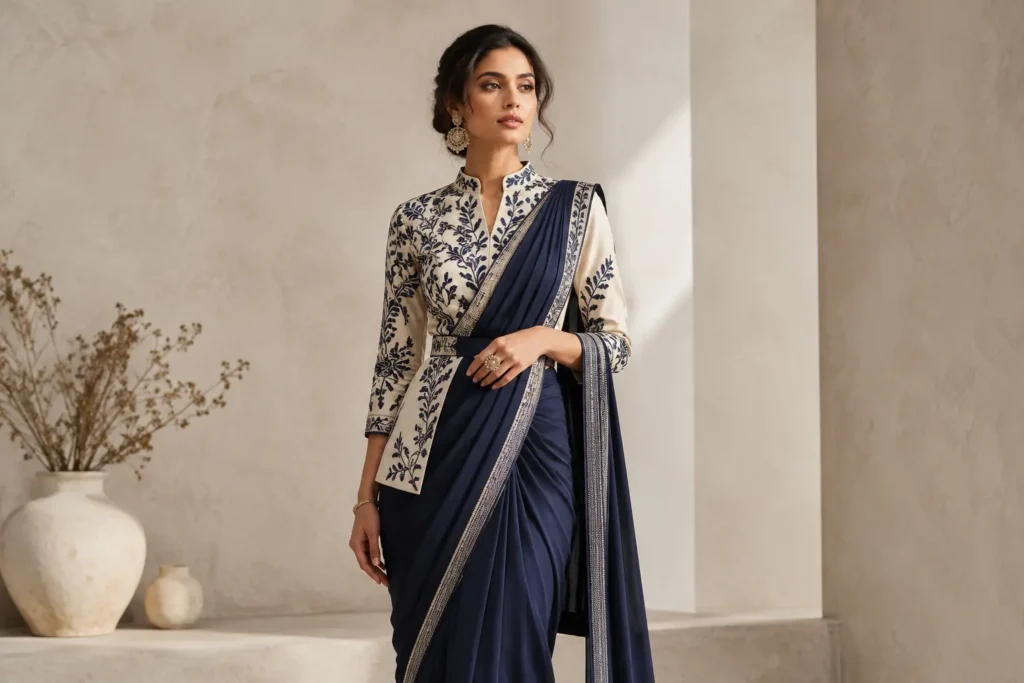
It takes a traditional Indian silhouette and interprets it through a contemporary lens. Think a kurta cut like a structured blazer. A lehenga skirt paired with a crop top instead of a traditional choli. A dhoti-style pant worn with an embroidered waistcoat.
Or it takes a Western silhouette and gives it an Indian soul. A shift dress in Banarasi silk. Wide-leg trousers in handblock cotton with a traditional border print. A co-ord set using fabric that would otherwise become a saree.
The result, when it works, is an outfit that doesn’t look like it’s trying to be two things at once. It simply looks like fashion — with significantly more interesting material stories behind it.
Fusion Wear for Women — Where the Category Really Stands in 2026
The Shift That Changed Everything
Fusion wear for women has moved through several phases since the mid-2000s when it first showed up as a commercial category. The early days were rough — a lot of kurtas with jeans that looked like an afterthought, or sarees styled with sneakers purely for shock value rather than any genuine aesthetic coherence.
What’s happened since is more interesting. Designers who actually understand both traditions — Western tailoring and Indian craft — have started doing the real work. The result is fusion wear for women that doesn’t look like a style experiment. It looks like clothes.
The dominant directions right now:
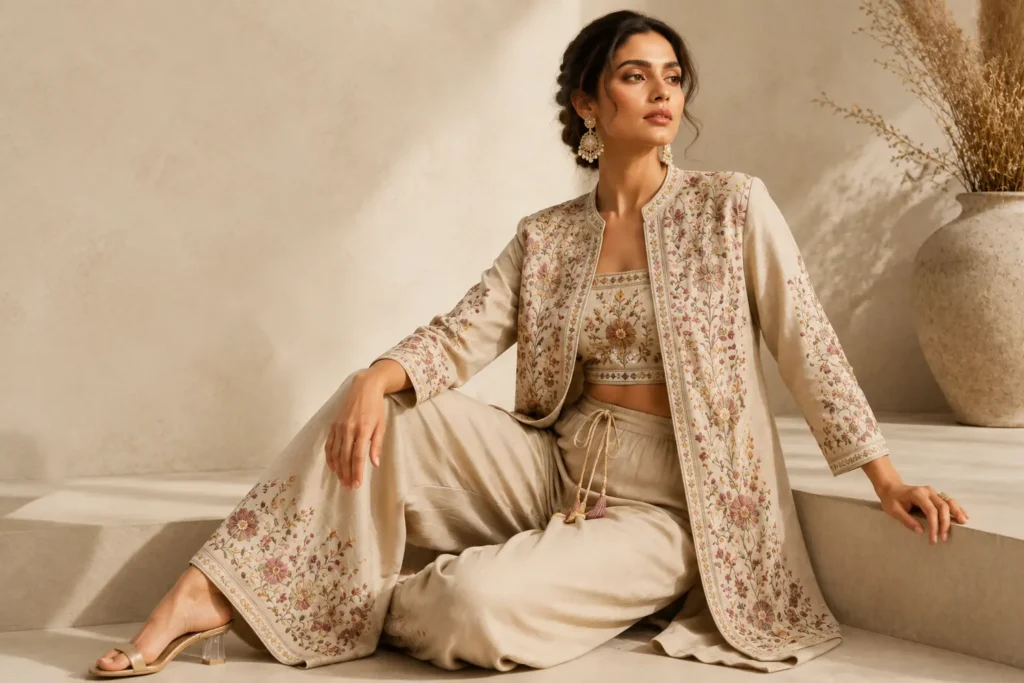
Embroidered co-ord sets — matching separates in hand-worked fabrics, worn as a unit or styled individually. The Indian version of the European power suit moment, but with considerably more interesting fabric stories.
Draped pants and dhoti-inspired silhouettes — traditional draping translated into structured, wearable trouser forms. Works across casual and occasion contexts depending on fabric choice.
The kurta-jacket hybrid — a longer kurta cut with the precision of a blazer, often in raw silk or handloom cotton. Probably the most versatile single piece in the Indo western category right now.
Fusion saree styling — the saree itself hasn’t changed, but how it’s styled has shifted completely. Structured blouses that look more like bodices. Pre-stitched pleats for ease of wear. Saree gowns that blur the line entirely.
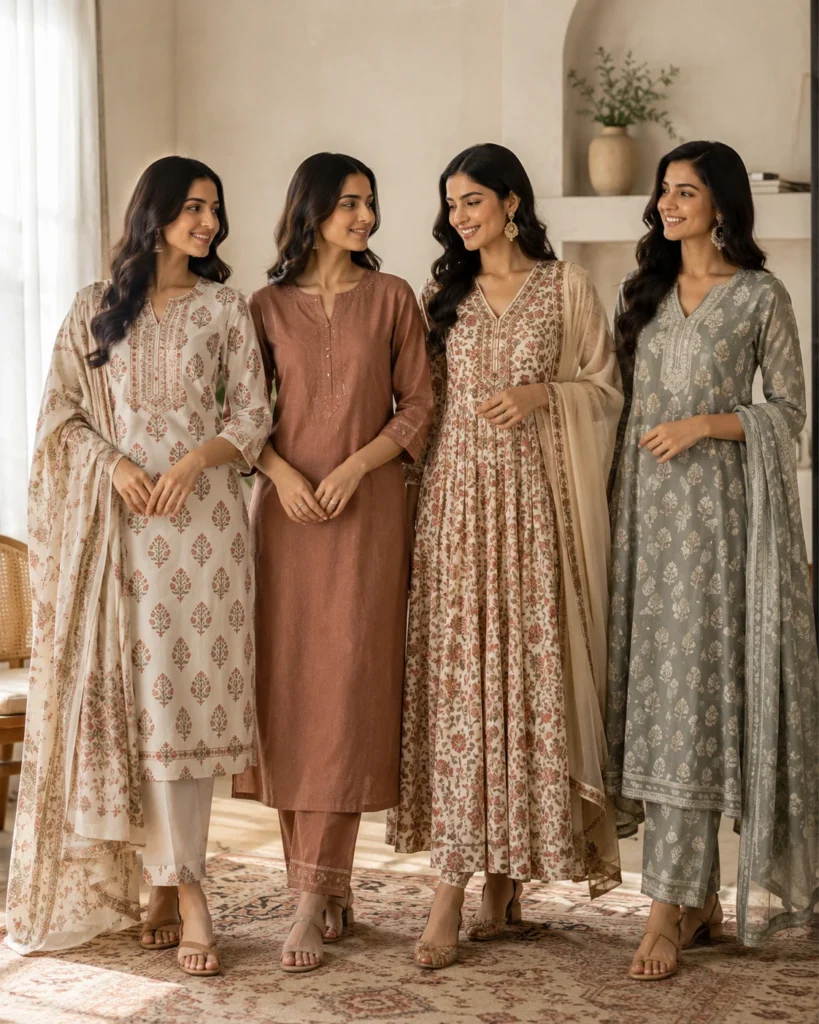
Kurta Set for Women — The Everyday Indo Western Essential
If there’s one category in the Indo western space that punches above its weight for everyday wearability, it’s the kurta set for women.
The coordinated kurta set — top, bottom, and often a dupatta — is the Indian equivalent of having a fully considered outfit without having to think too hard about it. Everything is designed to work together, which means you get the visual impact of a put-together look in the amount of effort it takes to put on a single outfit.
What Separates a Good Kurta Set from a Great One
The fabric is the first thing. A kurta set in machine-printed cotton will look like exactly that. The ones worth investing in — and wearing to occasions that matter — come in handloom, raw silk, chiffon, or georgette, with embellishment that reflects actual craft: chikankari, mirror work, hand block printing, or subtle zari.
The cut is the second thing. A kurta that hangs straight with no shaping looks shapeless on most bodies. The best kurta sets for women use princess cuts, side seam shaping, or structured shoulders to give the piece actual form.
Reina carries kurta sets across a wide price range — from the Orange Kurta Set (SG-KP-14) at ₹15,000 to the Yellow Kurta Set (SG-KP-16) at ₹32,000 — with the difference usually coming down to fabric provenance and embellishment quality.
How to Style a Kurta Set Beyond the Expected
The default move with a kurta set is to wear it as prescribed — kurta, palazzo or churidar, dupatta over one shoulder. That works. But there are more interesting options:
- Swap the bottoms — wear the kurta top over straight-cut trousers or wide-leg pants in a contrasting neutral
- Skip the dupatta and add a belt at the waist for a more structured, contemporary silhouette
- Layer with a jacket — a complementary short jacket or blazer over a kurta takes the look from occasion-wear to something you could wear to dinner without overthinking
- Use the dupatta differently — draped across the shoulder like a stole rather than the traditional style, especially for the shorter kurta sets
Bridesmaid Outfits India — Getting the Brief Right
Bridesmaid dressing in India has always been a particular kind of challenge. You need to look coordinated without looking identical. You need to complement the bride without competing with her. And you need an outfit that photographs well across every lighting condition a four-day wedding celebration throws at you — morning ceremony, afternoon lunch, evening sangeet, and the reception at night.
The Indo western category has become genuinely useful for bridesmaids precisely because it offers more range than either fully traditional or fully Western options.
The Bridesmaid Brief, Category by Category
For the Mehndi / Haldi
This is the ceremony where colour and looseness matter most. Fusion wear for women in bright or pastel tones — a printed co-ord set, a mirror-work kurta with palazzos, or an embroidered anarkali — works perfectly. You want pieces that move and photograph well outdoors, ideally in light fabrics that handle both sitting and dancing.
For the Sangeet
The sangeet is where bridesmaids have the most freedom — and the most pressure. Indo western outfits shine here because they allow individuality within a colour palette. A coordinated group in the same colour family but different Indo western silhouettes photographs beautifully and gives each bridesmaid the chance to wear something that actually flatters their individual body.
For the Wedding Ceremony
Here, the more traditional the bridesmaids, the better. A silk kurta set or a light saree keeps the focus on the bride and respects the ceremony’s register. The Indo western elements — a contemporary drape style, a structured blouse with interesting detailing — can be subtle.
For the Reception
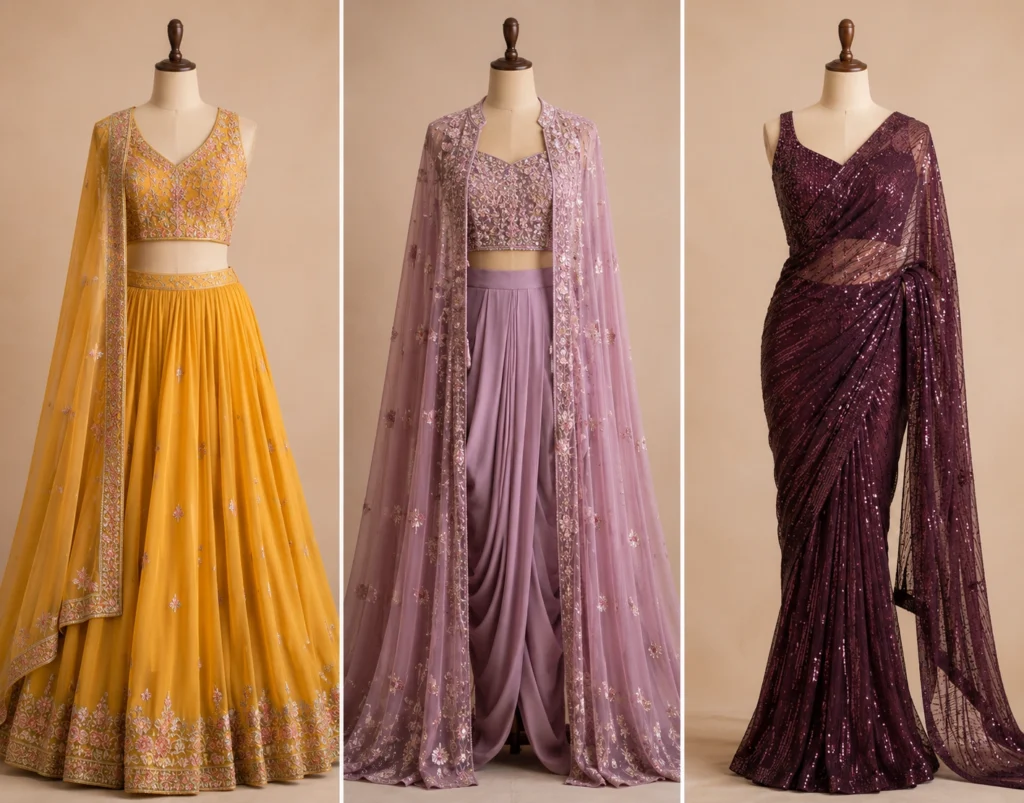
The reception is where a party wear saree or a fusion lehenga earns its place. The evening lighting rewards embellishment and rich fabrics. A well-chosen Indo western piece for the reception is the outfit that will get the most compliments across the weekend.
Party Wear Sarees — The Indo Western Take on an Eternal Silhouette
The saree is the original Indo western garment — centuries before the category had a name, Indian women were layering a single piece of unstitched cloth over blouses and petticoats in a way that produced one of the most sophisticated garments in the history of fashion.
The contemporary party wear saree is the direct descendant of that. It takes the same base garment and finds new ways to tell the story.
Party Wear Sarees That Are Actually Wearable
The tension in party wear sarees has always been between looking spectacular and being able to move. The traditional draping styles that look best in photographs are sometimes the ones that make dancing, sitting, or navigating a buffet table genuinely difficult.
The Indo western approach to party wear sarees addresses this directly. Pre-stitched pleats mean you can move without readjusting. Saree gowns eliminate the draping challenge entirely. And contemporary blouse designs — crop tops, structured bodices, off-shoulder cuts — give the saree a distinctly modern silhouette while keeping the fabric as the hero.
How to Build an Indo Western Wardrobe That Actually Works
The temptation with Indo western dressing is to buy occasion-specific. One outfit for the sangeet, one for the mehendi, one for a colleague’s wedding. This is expensive and leaves you with a wardrobe full of things that only work once.
A more useful approach:
Invest in Versatile Separates First
A well-chosen silk kurta top can be worn over palazzos for a traditional function, over straight trousers for a dinner, or belted over a skirt for something with an entirely different register. Separates that work across multiple combinations are always a better investment than complete outfits that only work as a unit.
Build Around Two or Three Core Colours
Indian festive fashion uses a wide colour range, but your most-worn pieces will be the ones that work with what you already own. A neutral base — ivory, champagne, deep wine, bottle green — makes it easier to mix and match without starting from scratch every time.
Choose Craft Over Trend
Trends in Indo western fashion move fast. The silhouette that’s everywhere this season will feel dated by the next. What doesn’t date is the quality of the craft — hand embroidery, natural dye work, fine weaving. Pieces built around real craft hold their value aesthetically in a way that trend-first fashion never does.
Where to Shop Indo Western Outfits in Hyderabad
Hyderabad’s fashion geography has shifted meaningfully over the past five years. The traditional shopping corridors — Begum Bazaar for fabrics, Laad Bazaar for bangles and accessories, specific streets in the old city for bridal wear — still exist and still serve a purpose. But for curated, multi-designer Indo western buying, Jubilee Hills has become the destination.
The logic is simple. A multi-designer boutique gives you a single, curated selection from multiple designers instead of a fragmented hunt across the city. You see the full range of what’s relevant in the current season, with styling advice from people who understand the full edit rather than just a single designer’s perspective.
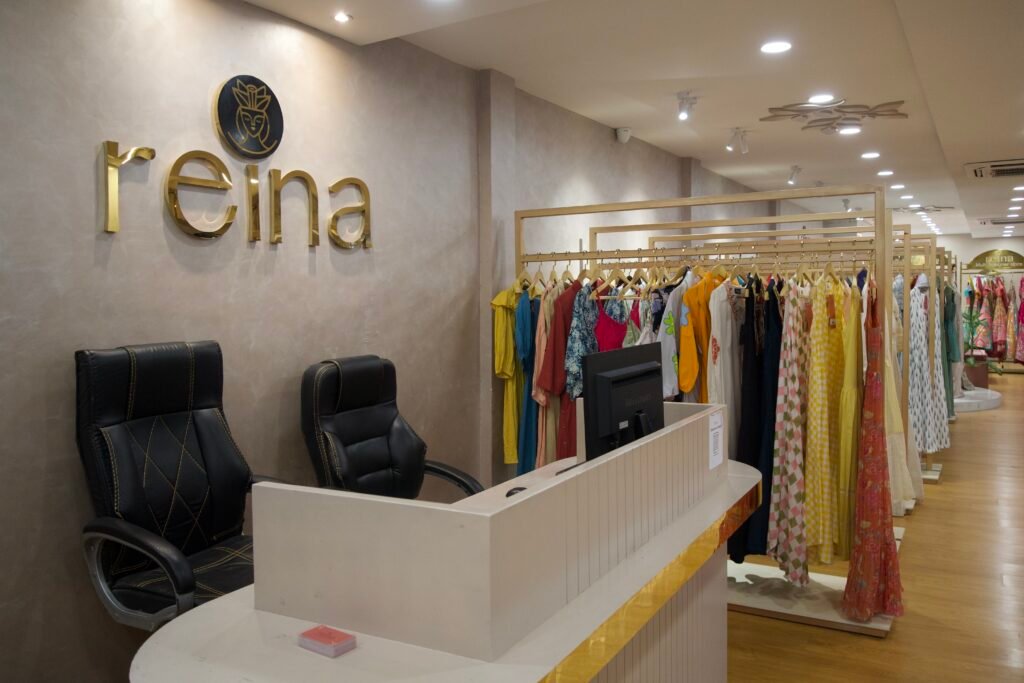
Reina in Jubilee Hills was built specifically around this idea. The selection brings together India’s finest designers under one roof, with an edit that spans sarees, kurta sets, fusion wear for women, lehengas, and everything in between — chosen for quality of craft and coherence of aesthetic rather than to represent every possible price point or occasion.
The video appointment service extends this further. If you can’t get to Jubilee Hills, a live video consultation with a Reina stylist gives you the same curated guidance — draping demonstrations, styling alternatives, and the same access to the collection — from wherever you are.
Your Wardrobe Is Waiting
The best Indo western outfit isn’t the most expensive one or the most elaborately embellished one. It’s the one that makes you feel entirely yourself — rooted in a tradition you’re proud of, dressed for the moment you’re actually living in.
Reina’s collection is built around that idea. Curated from India’s finest designers, carried across every category — fusion wear, kurta sets, sarees, lehengas — and available through the store in Jubilee Hills or via a live video appointment at a time that works for you.